
Equipment comparison
AUX vs Fujitsu Mini Splits: What the Certification Data Shows
By Advanced Ductless · Published · Last verified
Short answer
Start with the fact that reframes this whole comparison. About 40% of everything AUX built in 2024 — RMB 11.9 billion, roughly US$1.6 billion — was sold under other companies’ brand names. That is the audited figure from its stock-exchange listing, up from 35% in 2022 and running at 47% in early 2025. Two of every five air conditioners AUX makes are bought by another manufacturer that puts its own badge on the box.
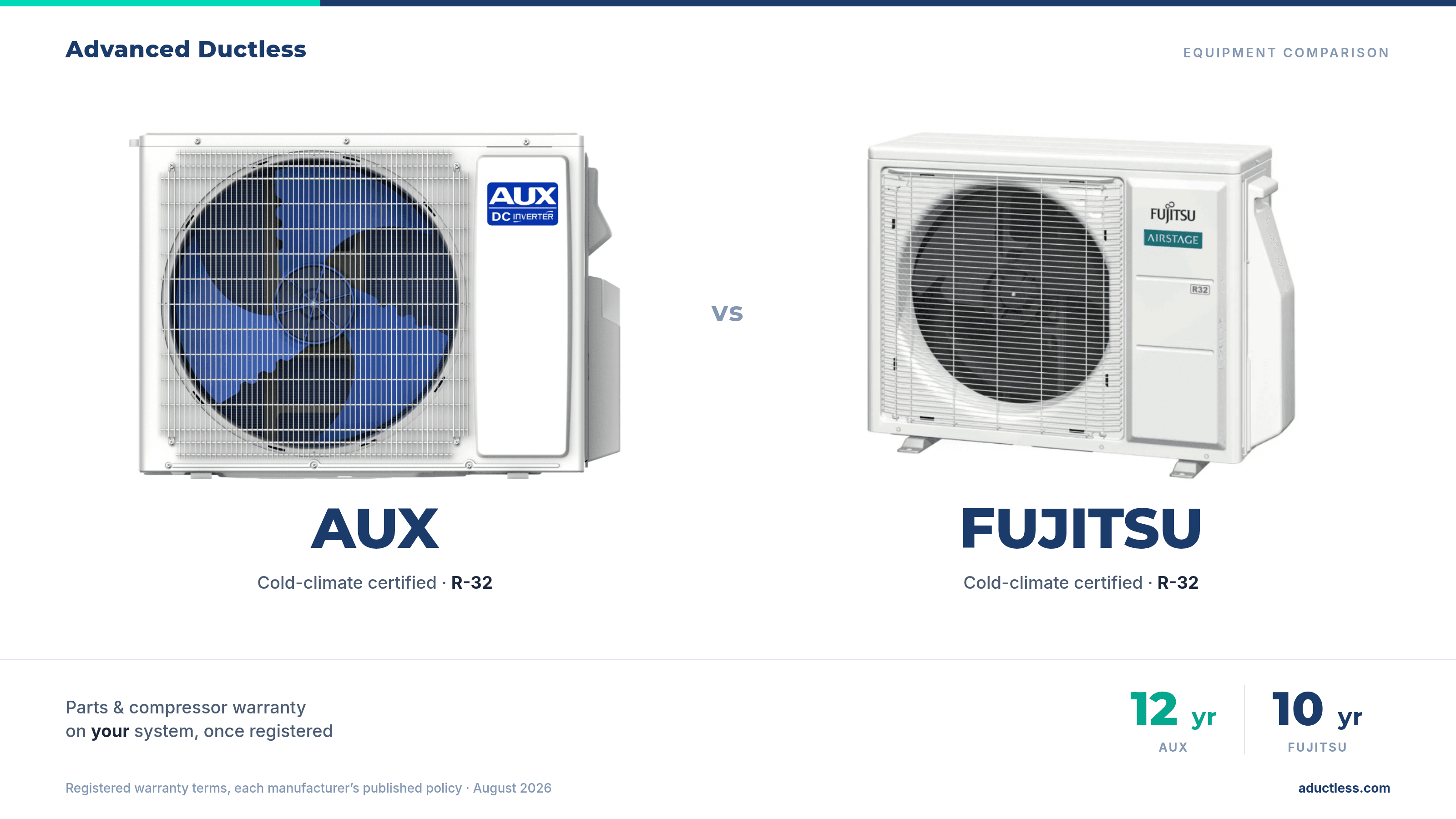
So the question is not whether AUX can build a good machine. On the EPA’s certification data the two brands land in the same class. Both have full cold-climate lineups. Matched at the same size, neither one wins across the board. AUX carries the longer warranty — 12 years registered against Fujitsu’s 10 — and its entire certified line uses R-32, where 39 of Fujitsu’s 85 certified outdoor units, just under half, still use the phased-out R-410A. In Massachusetts that difference has become the largest practical gap between the two lines — see below.
If you live somewhere with a real winter, a cold-climate certified unit is the right choice — and AUX makes those, so cold weather is not a reason to rule the brand out. Match two quotes on the things that matter for your house — cold-climate certification if you need it, enough capacity at 5 °F for your design load, R-32 refrigerant — and you are looking at equivalent equipment. At that point price decides, and that is where AUX wins.
We install ductless heat pumps across Greater Boston. This comparison uses two kinds of evidence only: the EPA’s ENERGY STAR certified product database, and each manufacturer’s own published warranty. Every number can be looked up.
How we compared them
Most brand comparisons pick one model from each manufacturer and generalise. That produces whatever answer the author wanted, because both brands sell everything from entry units to flagships.
So we did it differently. We pulled the EPA’s complete ENERGY STAR certified mini-split dataset — 17,325 records — and compared every certified model from each brand against every certified model from the other. The database lists one row per certified system — the same outdoor unit appears again for every indoor unit it pairs with — so we deduplicated to unique outdoor models first. Counting rows instead would simply reward whichever brand publishes more pairings. That leaves 97 AUX outdoor units against 85 Fujitsu, tested under the same procedure and reported to the same federal database.
What the certification data shows
| Metric | AUX (97 models) | Fujitsu (85 models) |
|---|---|---|
| Median SEER2 (seasonal cooling) | 22.00 | 22.20 |
| Median EER2 (cooling at 95 °F) | 12.00 | 13.00 |
| Models meeting the EER2 criterion | 45 of 97 (46%) | 79 of 85 (93%) |
| Median COP @ 5 °F (cold-weather efficiency) | 2.00 | 2.14 |
| Median HSPF2 (seasonal heating) | 9.50 | 10.80 |
| Lowest SEER2 in the lineup | 18.00 | 16.70 |
| Lowest COP @ 5 °F in the lineup | 1.80 | 1.76 |
| Models at SEER2 20 or better | 86.6% | 89.4% |
| Models at SEER2 22 or better | 52.6% | 62.4% |
| Line on R-32 refrigerant | 100% | 54% |
| Cold-climate certified models | 82 | 75 |
Four things stand out.
Cooling efficiency is a tie. Median SEER2 of 22.00 against 22.20 is a difference of under 1%. These are the same class of machine.
The AUX floor is higher than Fujitsu’s. The least efficient AUX certified model rates SEER2 18.00 and COP 1.80 at 5 °F. Fujitsu’s least efficient rates 16.70 and 1.76. Whatever AUX unit you end up with, the bottom of the range is better. Fujitsu takes the upper end, though: 89.4% of its line hits SEER2 20 or better against 86.6% of AUX’s, and 62.4% reaches SEER2 22 against 52.6%.
The entire AUX certified line is on R-32. All 97 models. 39 of Fujitsu’s 85 certified outdoor units — just under half — are still on R-410A, the refrigerant being phased out under the 2025 transition.
In Massachusetts this is no longer a question of long-term serviceability. It decides whether the equipment can earn a rebate at all. As of 1 January 2026, Mass Save® removed every system with a global warming potential above 700 — which is all R-410A — from its Qualified Product List, and ductless equipment got no transition allowance. We checked the published list: of 5,083 qualifying mini split outdoor units on it, not one uses R-410A.
So on the measure that decides a Massachusetts rebate, the gap between these two lines is wide, and it favours AUX. That is a fact about which manufacturer moved refrigerant earlier rather than a statement about build quality, and it says nothing about the measures where Fujitsu leads — which are set out above and below. Full method and the brand-by-brand counts are in our breakdown of what actually qualifies for a Mass Save® rebate.
Both brands have deep cold-climate lineups. 82 of the 97 AUX outdoor units and 75 of the 85 Fujitsu units carry the ENERGY STAR Cold Climate designation. A cold-climate series is not a point of difference between these two brands, or frankly between most serious manufacturers in 2026.
Where Fujitsu leads: seasonal heating efficiency. Median HSPF2 of 10.80 against 9.50, and the Fujitsu flagship line reaches 14.00 where the best AUX certified model reaches 11.00. That is a real difference at the top of the range. The ranges overlap at the bottom, though — Fujitsu’s cold-climate lineup starts at HSPF2 9.00, the same as an AJAN — so which model you are quoted decides this, not which brand.
Does AUX work in cold climates?
Yes. A model earns the ENERGY STAR Cold Climate designation by meeting a fixed federal specification: an HSPF2 of at least 8.5, a SEER2 of at least 15.2, at least 70% of rated capacity retained at 5 °F, and a COP of at least 1.75 at 5 °F.
82 of the 97 AUX outdoor units meet it. Here are the specific units we install, with their AHRI certificate references so you can verify each one independently:
| AUX model | Cold Climate | SEER2 | HSPF2 | Cap @ 5 °F | COP @ 5 °F | Refrigerant | AHRI ref. |
|---|---|---|---|---|---|---|---|
| AJAN09HP230V1CO | Yes | 22.00 | 9.20 | 9,200 BTU | 2.00 | R-32 | 214290013 |
| AJAN12HP230V1CO | Yes | 21.00 | 8.80 | 9,200 BTU | 2.10 | R-32 | 214290031 |
| AJAN18HP230V1CO | Yes | 20.00 | 9.00 | 14,200 BTU | 2.20 | R-32 | 214290028 |
| AJAN24HP230V1CO | Yes | 20.00 | 9.00 | 20,000 BTU | 2.10 | R-32 | 214290029 |
| AJAN36HP230V1CO | Yes | 20.00 | 8.55 | 23,800 BTU | 2.00 | R-32 | 214290030 |
A COP of 2.20 at 5 °F means the unit is still producing 2.2 units of heat for every unit of electricity it draws, at 5 °F outside. The higher-efficiency AUX C-Series goes further, reaching SEER2 25.00 and HSPF2 11.00.
Put directly against Fujitsu’s cold-climate models in the same database:
| Model | Brand | HSPF2 | Cap @ 5 °F | COP @ 5 °F |
|---|---|---|---|---|
| AJAN18HP230V1CO | AUX | 9.00 | 14,200 BTU | 2.20 |
| AOUH18KUAS1 | Fujitsu | 11.30 | 17,100 BTU | 2.20 |
| AOU18RLXFWH | Fujitsu | 10.00 | 19,000 BTU | 2.18 |
| AJAN24HP230V1CO | AUX | 9.00 | 20,000 BTU | 2.10 |
| AOUH24KUAS1 | Fujitsu | 10.80 | 23,600 BTU | 2.08 |
At 5 °F the AUX AJAN18 matches one Fujitsu 18k model and edges another; the AJAN24 edges the AOUH24KUAS1. The Fujitsu units carry more capacity at that temperature, which is worth having if you are sizing tight to a design load — though in eastern Massachusetts the 99% winter design temperature sits near +5 to +9 °F, so both brands are operating inside their certified range on essentially every winter day.
The practical takeaway: do not evaluate cold-weather capability by brand reputation. Look up the specific model’s COP and capacity at 5 °F in the AHRI directory or the ENERGY STAR database. The model number tells you the truth; the badge does not.
Which one is more efficient at cooling?
Fujitsu, and it is the clearest advantage either brand holds anywhere in this comparison. It is also the thing the cold-climate badge above does not tell you, which is why it sits here rather than in a footnote.
ENERGY STAR certifies heat pumps down two separate paths. The standard path requires a unit to clear an EER2 threshold — cooling efficiency measured at 95 °F, the temperature you actually care about in August. The cold-climate path substitutes a higher heating requirement and contains no EER2 criterion at all. The specification says so in its own words: cold-climate models are the ones “optimized for peak heating and part-load cooling performance.”
Across the whole database, deduplicated by outdoor unit, 52 of the 97 AUX units miss ENERGY STAR’s cooling efficiency criterion — 54%. For Fujitsu it is 6 of 85, or 7%. Every AUX unit we install is in the group that misses it. Median EER2 across the two lines is 12.00 for AUX against 13.00 for Fujitsu, where the all-brand median is 12.50.
Against the same matched pairs used in the next section:
| Capacity | Model | Brand | EER2 | Meets the EER2 criterion |
|---|---|---|---|---|
| 9,000 BTU | AJAN09HP230V1CO | AUX | 12.00 | No |
| AOUH09LEAS1 | Fujitsu | 12.50 | Yes | |
| 18,000 BTU | AJAN18HP230V1CO | AUX | 11.00 | No |
| AOU18RLXFWH | Fujitsu | 13.30 | Yes | |
| 24,000 BTU | AJAN24HP230V1CO | AUX | 11.50 | No |
| AOUH24KUAS1 | Fujitsu | 12.80 | Yes | |
| 36,000 BTU | AJAN36HP230V1CO | AUX | 10.10 | No |
| AOUH36KPAS1 | Fujitsu | 9.75 | No |
Fujitsu takes 9,000, 18,000 and 24,000 BTU outright. At 36,000 the pattern breaks — both units miss the criterion, and the AUX is the more efficient of the two. That is the only capacity in the set where this measure favours AUX, and we would rather point at it than let you find it yourself.
Read this precisely, because it is easy to overstate. Missing the criterion is not a capacity rating and it does not mean a unit cools badly. EER2 is an efficiency ratio: these units cool the room, they simply draw more power to do it on the hottest days of the year. The cost lands on an August electricity bill, not on whether the house gets cold.
What to do with it depends on where you are. If you are somewhere cooling runs hard for five months, weight this heavily and it points at Fujitsu. In eastern Massachusetts, where the cooling season is short and the heating season is the one that moves the annual bill, SEER2 and HSPF2 carry more of your running cost than peak EER2 does — but if the summer bill is specifically what worries you, this is the number to compare, and we have just told you which way it goes.
Matched spec for spec, the machines are equivalent
This is the part that should decide your purchase, so it is worth being concrete. Take each AUX unit we install, find the closest Fujitsu cold-climate model at the same capacity, and put the certified numbers side by side:
| Capacity | Model | Brand | SEER2 | HSPF2 | Cap @ 5 °F | COP @ 5 °F |
|---|---|---|---|---|---|---|
| 9,000 BTU | AJAN09HP230V1CO | AUX | 22.00 | 9.20 | 9,200 | 2.00 |
| AOUH09LEAS1 | Fujitsu | 21.30 | 10.00 | 8,100 | 1.96 | |
| 18,000 BTU | AJAN18HP230V1CO | AUX | 20.00 | 9.00 | 14,200 | 2.20 |
| AOU18RLXFWH | Fujitsu | 20.00 | 10.00 | 19,000 | 2.18 | |
| 24,000 BTU | AJAN24HP230V1CO | AUX | 20.00 | 9.00 | 20,000 | 2.10 |
| AOUH24KUAS1 | Fujitsu | 21.70 | 10.80 | 23,600 | 2.08 | |
| 36,000 BTU | AJAN36HP230V1CO | AUX | 20.00 | 8.55 | 23,800 | 2.00 |
| AOUH36KPAS1 | Fujitsu | 21.00 | 10.00 | 25,800 | 2.20 |
Read the highlighted cells and notice that they land on both sides. At 9,000 BTU the AUX unit is the more efficient machine on three of the four measures. At 18,000 BTU the two are tied on SEER2 to the second decimal, and AUX edges the COP at 5 °F. At 24,000 and 36,000 BTU Fujitsu takes most of the columns. Nobody sweeps.
That is the whole point. These are the same class of equipment, certified under the same federal test procedure, and the specification sheet does not pick a winner. Which means the specification sheet is not what you should be choosing on — and neither is the badge.
What to actually compare: start with where the house is. In New England, the upper Midwest, or anywhere else with a real heating season, you want a cold-climate certified unit — and both brands make them, so that requirement rules neither one out. In a mild climate it matters far less and you can weigh cooling efficiency more heavily. From there, check that the capacity at 5 °F covers your design load, that the unit uses R-32 rather than phased-out R-410A, and pick the efficiency tier your heating bill justifies. Once two quotes clear the tests that apply to your house, you are looking at equivalent machines — and the honest remaining difference is price and warranty. That is where AUX wins, and it is the reason we install it.
Warranty: 12 years vs 10 years
| AUX | Fujitsu | |
|---|---|---|
| Standard (no registration) | 5 yr parts / 7 yr compressor | 5 yr parts / 7 yr compressor |
| Registered | 12 yr parts + compressor | 10 yr parts + compressor |
| 12 years requires | Registration within 60 days | Registration + installation by a Fujitsu Elite Contractor |
| Labor included | No | No |
The standard terms are identical. The difference appears at registration: AUX gives you 12 years on parts and compressor. Fujitsu gives you 10. The Fujitsu 12-year term exists but is gated behind Elite Contractor status, a dealer program with training and volume requirements that most Fujitsu installers do not hold. If your installer is not Elite, your Fujitsu warranty is 10 years.
AUX calls its registered tier “12 / 12 coverage” — 12 years parts, 12 years compressor. Its published warranty policy states the terms directly: without registration, “the parts warranty lasts up to 5 years, and the compressor warranty lasts up to 7 years after the installation date”; with registration completed online within 60 days of installation, coverage upgrades to the 12-year parts and compressor Extended Warranty.
Two conditions are worth knowing. Coverage runs from the installation date and stays with the original installation address — it is not transferable if the unit is moved. And the AUX warranty does not cover units sold over the internet, by telephone, or through non-authorized distributors or dealers. That is a further reason the professionally installed equipment discussed here sits under different terms from anything bought through a retail or online channel, and a reason to have a licensed contractor source the equipment.
A note on a common error: some comparisons cite a much shorter AUX warranty. That figure comes from the warranty document for the AUX retail channel — units sold through big-box stores — which is a different product line under different terms from the professionally installed ductless systems covered here. If a licensed contractor is quoting you an AUX ductless system, the registered term is 12 years.
Why AUX costs less
Not because the equipment is a step down — the certification data above shows the two brands performing in the same class, with AUX ahead on refrigerant, on efficiency floor, and on warranty length.
The price difference comes from how the brand reaches the customer. AUX is one of the largest air conditioning manufacturers in the world, and that scale plus a leaner distribution model means less cost added between the factory and your wall:
- Founded in 1986 — a manufacturer with roughly four decades of continuous production behind it.
- The fourth-largest household air conditioner company in the world by 2024 sales volume, per the Frost & Sullivan data in its listing prospectus.
- Publicly listed on the Hong Kong Stock Exchange since September 2025 (ticker 2580.HK), with audited financials and public disclosure obligations.
- 40.1% of 2024 revenue — RMB 11.9 billion, about US$1.6 billion — came from building air conditioners sold under other companies’ brands. That is the audited figure for its overseas ODM business, up from 35.2% in 2022 and running at 46.8% in the first quarter of 2025.
- It co-develops compressor technology with Panasonic and began mass-producing its own compressors in June 2025 — vertical integration on the single most important component in the system.
The fourth point is the one worth sitting with. An ODM builds products that ship under someone else’s brand name, so that 40.1% figure means roughly two of every five air conditioners AUX sells are sold to another manufacturer willing to stake its own reputation on AUX’s production line and pass that company’s quality audits to do it. You are not paying less for a lesser machine; you are paying less because AUX has not built its US pricing around a legacy premium-brand markup.
It is also worth knowing which way the business grew. AUX built its scale as a contract manufacturer first and has been pushing its own brand more recently — its prospectus puts it as “not being limited to mere ODM model, we consistently enhanced our capabilities to promote our own brands,” listing sales operations established in the US among other markets. That is the ordinary reason a manufacturer with this much production behind it can be newer to you as a brand name, and part of why its pricing is not carrying decades of brand premium.
We are deliberately not naming those ODM customers. AUX’s own marketing materials list several well-known brands, but its listing prospectus anonymises every customer, so we have no independently verifiable source and will not repeat a claim we cannot document. The revenue figure above is audited, and it makes the point without needing the names.
This is the sweet spot the brand occupies: high-quality equipment at a price that makes a heat pump project actually affordable.
Parts and service
AUX operates a US headquarters in South Plainfield, New Jersey, supporting a distributor and dealer network across the country, with distributors carrying stocked inventory rather than ordering unit by unit. Because the entire AUX certified line is already on R-32, its parts and equipment supply is aligned with the current refrigerant standard rather than straddling a transition.
The published warranty process is more concrete than most manufacturers’. AUX operates what it calls a $0 warranty process: approved parts ship directly to the distributor, and standard shipping is covered by AUX, with expedited shipping available at the requester’s cost. Claims can be filed online or by phone with a US technical support line, and approved parts ship to the distributor on file rather than being drop-shipped to a homeowner. Compressors, main PCB boards and inverter boards require advance technical approval, which is standard practice for high-value components.
In our own experience as an installer, AUX parts have not been a problem. We would rather you not take that on faith, though, because the honest answer is that parts availability is far more about your contractor than about the badge on the condenser. Ask whoever is quoting you:
- When you have needed a warranty part for this brand, how long did it take to arrive?
- Do you stock common failure parts — control boards, sensors, fan motors — for the systems you install?
A contractor who cannot answer those questions is the actual risk in the transaction.
What actually determines how long it lasts
This gets almost no attention in brand comparisons and it matters more than the badge. A well-installed system will routinely outlast a poorly installed one of any brand. Here is what separates them.
Evacuation. Moisture left in the refrigerant circuit reacts with the oil to form acid, which destroys the compressor from the inside over a period of years. The system must be pulled into a deep vacuum — 500 microns or below — and then pass a decay test with the pump valved off, proving the vacuum holds. A technician who watches the clock instead of the micron gauge does not know whether the system is dry. In our experience this single step is the most common difference between a system that reaches its warranty term and one that does not.
Nitrogen purge while brazing. Brazing copper with air inside the line forms cupric oxide scale on the interior walls. That scale flakes off and circulates, clogging metering devices and scoring the compressor. Flowing dry nitrogen through the line during brazing prevents it. It takes a few extra minutes and it is skipped constantly.
Flare and torque discipline. Ductless systems live or die on their flare connections. A flare cut with a worn tool, or torqued by feel instead of to the manufacturer’s specification, is a slow refrigerant leak. A system running low on charge runs hot and fails early.
Correct sizing via Manual J load calculation. Oversizing is the most common design error in residential HVAC, and on a heat pump it is actively harmful. An oversized system satisfies the thermostat quickly and shuts off, which means it never runs long enough to pull moisture out of the air. The result is a house that hits its temperature setpoint and still feels clammy — and short cycling puts wear on the compressor and inverter that steady operation does not. Bigger is not safer. A proper load calculation is what tells you the right size; any contractor sizing off square footage alone is guessing.
Commissioning and documentation. Verified charge, superheat and subcooling checked against spec, airflow confirmed, delta-T measured, and the numbers written down. Without a commissioning record there is no way to know whether the system left the driveway operating correctly, and no baseline to diagnose against in year six.
Warranty registration. Both brands require it for the extended term, and the AUX window is 60 days. There is no charge and it takes minutes. Ask your contractor to confirm in writing that it was filed.
If you are comparing quotes, these are better questions than “what brand do you install?” A contractor who can talk fluently about micron levels, nitrogen purge and Manual J is telling you more about your system’s future than the brand name is. It is also most of what we cover in how we approach an installation.
What our customers say after switching
We have moved customers from Fujitsu and Mitsubishi systems onto AUX equipment. The response we hear most is about noise — customers describe the units as noticeably quiet — along with comfort and price. Several have told us they had not heard of the brand before and were surprised by the result.
That is our first-hand experience as an installer across a number of jobs. It is not a controlled comparison, and part of what those customers are responding to is the installation work rather than the equipment alone. We report it as what it is.
Frequently asked questions
Is AUX a good brand?
Yes. AUX is a premium-quality global manufacturer that competes on price rather than on brand markup. It has been building air conditioning equipment since 1986, is the fourth-largest household air conditioner company in the world by 2024 sales volume, and is publicly listed on the Hong Kong Stock Exchange. Its audited listing prospectus shows 40.1% of 2024 revenue — RMB 11.9 billion, about US$1.6 billion — came from its ODM business, meaning air conditioners it builds that ship under other companies’ brand names. On the EPA certification data its median SEER2 of 22.00 is statistically level with Fujitsu 22.20, and its entire certified line runs R-32 refrigerant.
Is AUX as good as Fujitsu?
On most of the certification data they are in the same class, with one clear exception. Across every model each brand has certified with the EPA, median SEER2 is 22.00 for AUX and 22.20 for Fujitsu. The AUX efficiency floor is higher, AUX carries the longer warranty at 12 years registered against Fujitsu 10, and the AUX certified line runs R-32 where just under half of Fujitsu is still on phased-out R-410A. Fujitsu leads on seasonal heating efficiency, with a median HSPF2 of 10.80 against 9.50. The exception is cooling efficiency at 95 degrees Fahrenheit, where Fujitsu leads clearly: 52 of 97 AUX outdoor units miss ENERGY STAR EER2 criterion against 6 of 85 Fujitsu, because cold-climate certification carries no EER2 requirement. That is an efficiency measure rather than a capacity one, so it shows up on a summer electricity bill rather than in whether the room gets cold. Compare the EER2 and HSPF2 of the specific models on your quotes rather than the brands.
Does AUX work in cold climates?
Yes. 82 of the 97 AUX ENERGY STAR certified outdoor units carry the Cold Climate designation, meeting the same federal specification that Fujitsu cold-climate models meet. The AJAN series holds a coefficient of performance (COP) of 2.00 to 2.20 at 5 degrees Fahrenheit, within the range of comparable Fujitsu models, and the higher-efficiency AUX C-Series reaches SEER2 25.00 and HSPF2 11.00.
What is AUX's warranty compared to Fujitsu's?
Both offer 5 years parts and 7 years compressor when unregistered. Registered, AUX provides 12 years on parts and compressor — what AUX calls 12/12 coverage — while Fujitsu provides 10 years, with a 12-year Fujitsu term available only when the system is installed by a Fujitsu Elite Contractor. AUX registration must be completed online within 60 days of installation. Neither manufacturer includes labor.
Why is AUX less expensive than Fujitsu?
Distribution and market position, not equipment quality. AUX is the fourth-largest household air conditioner manufacturer in the world by 2024 volume and reaches US customers through a leaner distribution model, so less cost is added between the factory and the installation. The EPA certification data shows the two brands performing in the same class, with AUX ahead on refrigerant, efficiency floor and warranty length.
Are AUX parts hard to get?
No. AUX operates a US headquarters in South Plainfield, New Jersey, supporting a national distributor and dealer network with stocked inventory. Its published warranty process is what AUX calls a $0 warranty process: approved parts ship directly to the distributor with standard shipping covered by AUX, filed online or through a US technical support line. Parts availability depends far more on whether your contractor stocks common parts and how quickly they process warranty claims than on the brand itself.
Does AUX qualify for Mass Save® rebates?
Yes, and on this specific point the AUX line has a real advantage in Massachusetts. Since 1 January 2026, Mass Save® has removed every system with a global warming potential above 700 — which is all R-410A — from its Heat Pump Qualified Product List, and ductless equipment received no transition allowance. Checking the published list, of 5,083 qualifying mini split outdoor units not one uses R-410A. The entire AUX certified line runs R-32, so none of it was caught by that rule, while 39 of Fujitsu 85 certified outdoor units are still on R-410A. That reflects which manufacturer moved refrigerant earlier rather than build quality, and it does not carry over to the measures where Fujitsu leads, such as cooling efficiency at 95 degrees Fahrenheit and seasonal heating efficiency. Confirm the specific model against the current Qualified Product List before you buy, since the list is revised continuously.
Do I need a cold-climate heat pump?
It depends on where the house is. In New England, the upper Midwest, or anywhere else with a real heating season, yes — a cold-climate certified unit is the right choice, because it is tested and rated to hold useful heating capacity and efficiency down at 5 degrees Fahrenheit rather than falling off when you need it most. In a mild climate it matters much less, and you can weigh cooling efficiency and price more heavily. The important thing for brand choice is that cold-climate models are widely available: 82 of the 97 AUX ENERGY STAR certified outdoor units carry the Cold Climate designation, as do 75 of Fujitsu 85. Needing cold-weather performance does not narrow you to one brand.
What should I look for when comparing mini split brands?
Compare specific models, not brands. Start with your climate: if you have a real heating season, look for ENERGY STAR Cold Climate certification on the exact model quoted — not just a brand claiming a cold-climate series, which nearly every manufacturer has. Then check the heating capacity at 5 degrees Fahrenheit actually covers your design load, confirm the unit uses R-32 rather than the phased-out R-410A since that affects rebate eligibility and long-term serviceability, and pick the efficiency tier your heating bill justifies by comparing SEER2 and HSPF2 of the quoted models. Once two systems pass the tests that apply to your house, they are equivalent machines, and the honest remaining differences are price, warranty and the quality of the installation.
Should I choose AUX or Fujitsu?
Choose on specification, not on brand. Matched at the same capacity the two are equivalent machines — AUX is more efficient on three of four measures at 9,000 BTU, the two tie on SEER2 at 18,000 BTU, and Fujitsu leads at 24,000. Once both quotes are ENERGY STAR Cold Climate certified, use R-32, and carry enough capacity at 5 degrees Fahrenheit for your design load, the specification sheet stops separating them. What is left is price and warranty, and AUX wins both: a meaningfully lower installed cost and 12 years registered against 10. Choose Fujitsu if you want the very highest seasonal heating efficiency on the market and the premium fits your budget. In either case installation quality will affect your outcome more than the brand.
Summary
- AUX is a large manufacturer that is new as a brand name. About 40% of its 2024 output — RMB 11.9 billion, roughly US$1.6 billion — was built for other companies’ brands. It grew up as a contract manufacturer and is expanding its own-brand line more recently.
- On certified performance the two are the same class. Median SEER2 22.00 against 22.20. Matched at the same capacity, neither sweeps — AUX leads at 9,000 BTU, they tie on SEER2 at 18,000, Fujitsu leads at 24,000 and 36,000.
- Fujitsu leads clearly on cooling efficiency at 95 °F. 52 of 97 AUX units miss ENERGY STAR’s EER2 criterion against 6 of 85 Fujitsu, and every AUX unit we install is in that group. Cold-climate certification carries no EER2 requirement, which is how. It is an efficiency measure, not a capacity one — the cost shows up on an August bill, not in whether the room gets cold. At 36,000 BTU both brands miss it and AUX is the more efficient of the two.
- Fujitsu leads on heating efficiency and cold-weather headroom. Median HSPF2 10.80 against 9.50, a top end of 14.00 against 11.00, and generally more capacity at 5 °F. It also takes the upper efficiency band: 62.4% of its line reaches SEER2 22 against 52.6% of AUX’s.
- AUX leads on refrigerant, and in Massachusetts that is now the widest practical gap between the two. Its certified line is entirely R-32; 39 of Fujitsu’s 85 certified outdoor units are still on R-410A. Since 1 January 2026 no R-410A system qualifies for a Mass Save® rebate — of 5,083 qualifying mini splits on the list, not one uses it. AUX also carries the longer warranty, 12 years parts and compressor registered against Fujitsu’s 10.
- Cold-climate certification matters if your climate calls for it. In a real heating season, look for it on the specific model — both brands offer it, so the requirement narrows you to neither.
- Parts availability is a contractor question more than a brand one. AUX publishes a $0 warranty parts process shipping to the distributor with freight covered. Ask whoever quotes you what their actual turnaround has been.
- Installation decides the lifespan. Deep vacuum to 500 microns with a decay test, nitrogen purge while brazing, torqued flares, and a Manual J load calculation matter more to how long a system lasts than the badge on it.
- What to do with your quotes. Ask for the exact model number on each, look up its SEER2, HSPF2 and 5 °F capacity, and confirm the refrigerant. Once two systems match on the things your house needs, the remaining difference is price, warranty and the installer.
Sources
- ENERGY STAR Certified Mini-Split Heat Pumps — US EPA open dataset (17,325 rows; 97 AUX and 85 Fujitsu unique outdoor units after deduplication). data.energystar.gov
- AHRI Directory of Certified Product Performance — ahridirectory.org
- Fujitsu General America limited warranty — fujitsugeneral.com
- AUX Warranty Policy (AUX Cloud Commerce USA Inc.) and AUX Air USA Warranty Process Guide, v1.0, last updated 3 July 2026 — us.auxair.com/warranty
- AUX corporate profile — auxair.com
- AUX Electric HKEX listing (2580.HK), September 2025
- ENERGY STAR Cold Climate criteria: HSPF2 of at least 8.5, SEER2 of at least 15.2, at least 70% capacity retention at 5 °F, and a COP of at least 1.75 at 5 °F
All figures verified . Specifications and warranty terms change — check the linked sources before relying on any figure here.
Related reading
- Mass Save® rebates for heat pumps — what qualifies and how much it pays
- Mass Save® commercial heat pumps in 2026 — what changed for Greater Boston small businesses
- What to expect at a no-cost energy assessment
- Heat pump FAQ
Disclosure. Advanced Ductless installs ductless heat pump systems in Massachusetts, including AUX equipment. Every claim here is drawn from federal certification data or manufacturers’ published documents so that you can verify it independently rather than take our word for it.